



Yes, synthetic urine can pass a drug test, but only if the sample stays between 90°F and 100°F at the moment of submission and clears specimen validity testing (SVT) for creatinine, pH, and specific gravity. Miss either one, and a lab flags it before anyone even runs a drug panel. PassUSA sells lab-grade formulas built to clear SVT, but no product overrides bad execution.
TL;DR:
- Synthetic urine can pass drug tests if kept between 90°F and 100°F at submission and if it passes all specimen validity checks for creatinine, pH, and specific gravity.
- Proper heating methods include wrapped heating pads or body heat, while microwaving carries a high risk of uneven heating and chemical breakdown, making timing critical.
- Passing standard specimen validity tests does not guarantee bypassing synthetic-detection screening, which looks for chemical signatures unique to production processes.
- Reheating synthetic urine multiple times degrades its chemical properties, increasing the chance of detection and making single-use warming essential.
- Employers are increasingly employing advanced detection methods like observed collection, hair follicle, or saliva testing to combat substitution attempts.
Table of Contents
- How to prepare and warm synthetic urine correctly
- Concealment and getting the sample to the test site
- What does specimen validity testing actually check?
- Can you reheat synthetic urine safely?
- Legal risks and what employers do to stop substitution
- Why most guides oversell the certainty here
- Get a lab-grade kit built for both hurdles
- Sources
How to prepare and warm synthetic urine correctly
Preparation separates a clean pass from an obvious flag, and most of it comes down to two things: what’s in the bottle and how hot it gets. Premixed synthetic urine is ready to heat straight out of the box. Powdered versions need to be reconstituted first, and that step trips up more people than it should.
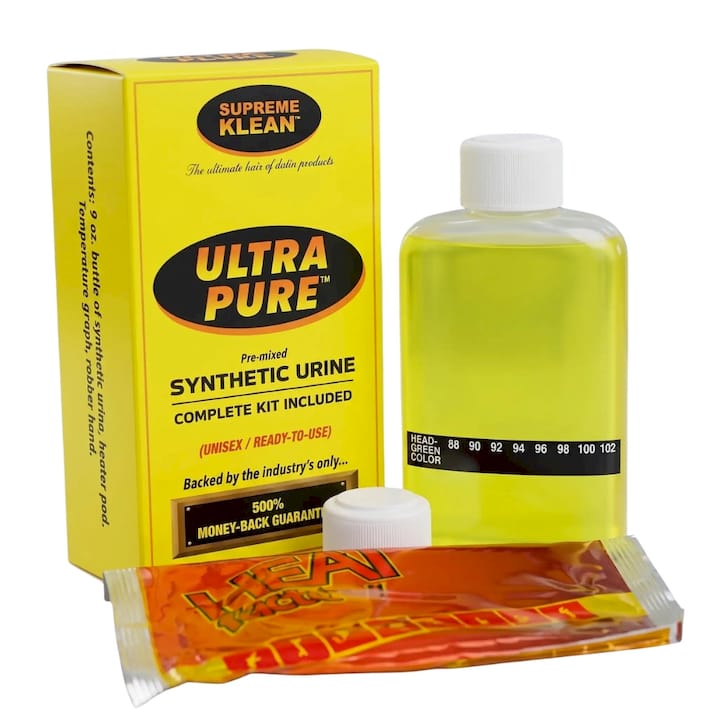
If you’re working with powder, mix it with distilled or filtered water, never tap water. Tap water carries mineral content and chlorine byproducts that can skew the pH and specific gravity readings a lab checks during SVT. Follow the fill line printed on the bottle exactly. Overfilling dilutes the creatinine concentration below what SVT flags as human-consistent, underfilling concentrates it too high. Both directions raise a red flag.
Check the expiration date before you do anything else. Synthetic urine is a chemical formulation, and the compounds that mimic uric acid and creatinine break down over time. An expired sample might look and smell fine and still read wrong on a lab panel.
Heating methods that actually work
Once mixed, the sample needs to reach body temperature range without cooking the chemistry inside it. Here’s how the common methods stack up:
- Heating pad or adhesive hand warmer. Wrap the pad around the bottle and let it warm gradually over 30 to 45 minutes. This is the steadiest method because it heats evenly instead of creating hot spots.
- Body heat. Taping the bottle against your skin for an extended period works but takes longer and is harder to monitor precisely.
- Microwave, as a last resort only. Heat in five-second bursts, checking temperature after each one. Microwaves heat unevenly, and a few extra seconds can push the sample well past 100°F or break down the synthetic compounds that mimic real urine chemistry, according to product guidance compiled by Omaada. If you use this method, shake the bottle between bursts to distribute heat evenly.
The target window is within the typical body temperature range, a range echoed across independent product writeups and consistent with what labs expect from a freshly voided sample, since testing sites check temperature soon after collection. Anything outside that range, high or low, is grounds for an on-site rejection before the sample ever reaches a lab.
Use a temperature strip attached to the bottle for a quick visual read, and back it up with a digital thermometer if you have one handy. Strips can lag a degree or two behind the actual liquid temperature, so don’t rely on one alone if the reading sits right at the edge of the range.
Pro Tip: Heat the sample as close to your appointment time as possible, ideally within the last hour before you leave. Synthetic urine cools roughly one degree every few minutes once removed from a heat source, so timing your heating too early means you’re gambling on ambient temperature to hold the line for you.
Treat every bottle as single-use. Once opened and exposed to air, the sample begins to change chemically, and reheating a previously opened bottle multiple times compounds that risk, which the next section covers in more detail.
Concealment and getting the sample to the test site
Keeping the sample warm during transport is where a lot of careful preparation falls apart. The gap between your car and the collection room is where temperature loss happens fastest, and it’s also where a rushed, obvious motion at the handoff gives away more than any lab result would.
Insulated waistbands, thigh straps, and pouches designed to sit against the body are the most reliable way to hold temperature during the ride over, since constant skin contact acts as a passive heat source. Whatever you use, plan the heating schedule around your actual appointment time rather than a rough estimate. If your appointment slips by twenty minutes, that’s twenty minutes the sample is losing heat.
Collectors follow a fairly consistent routine on arrival, and knowing it in advance helps you avoid unnecessary suspicion:
- Most sites ask you to empty pockets, remove bulky outerwear, or leave bags outside the collection room.
- Specimen cups often have a built-in temperature strip that the collector reads within a minute or two of you handing over the cup.
- Collectors work on a clock. Extended time in the bathroom or unusual movements before handing off the cup draw attention.
- Some sites use bluing agents in the toilet water and shut off the water supply, standard countermeasures against tampering.
A few practical rules for the handoff itself:
- Don’t linger unnecessarily before handing over the cup.
- Don’t try to check the temperature strip in front of the collector; verify it before you walk in.
- Don’t wear anything that makes an obvious bulge or requires visible adjustment.
- Do act as if this is routine. Hesitation and over-explaining are what collectors remember.
None of this guarantees a smooth handoff, but rushed, visibly nervous behavior is what turns a routine collection into an observed one.
What does specimen validity testing actually check?
SVT is the reason a warm, visually normal sample can still fail. Labs run a set of chemical checks that have nothing to do with drug metabolites and everything to do with whether the liquid in the cup came from a human body recently.
The core panel includes creatinine, pH, and specific gravity within human-consistent ranges Quest Diagnostics lists these alongside uric acid and oxidant checks as standard parts of validity testing. A sample that’s too dilute, too concentrated, or missing expected metabolic byproducts gets flagged as substituted or adulterated, regardless of temperature.
Some commercial synthetic urine products passed basic SVT checks in controlled testing, while specialized on-site synthetic-detection strips caught several of the same products that had cleared the standard panel. Direct observation of the collection was recommended as the most reliable way to prevent substitution altogether.
That finding comes from a peer-reviewed evaluation published on PubMed, and it’s the clearest evidence available that passing SVT and passing a synthetic-specific check are two different hurdles.
That second hurdle is getting harder to clear. Detection technology has moved past the basic four-panel SVT check. Tools like BioDetect™ look for manufacturing-consistent markers, chemical signatures left behind by the production process itself, that don’t appear in human urine no matter how well a formula mimics creatinine and pH. On-site synthetic urine test strips work similarly, screening for compounds that simply shouldn’t be present in a real sample.
In one experimental evaluation, five of eight commercial synthetic urine products cleared standard SVT, but several were still caught by the dedicated synthetic checks. That gap between “passes specimen validity testing (SVT)” and “passes synthetic detection” is where a lot of confidence turns out to be misplaced. A sample can hit the right temperature, the right pH, and the right specific gravity, and still get flagged the moment a lab runs a synthetic-specific screen.
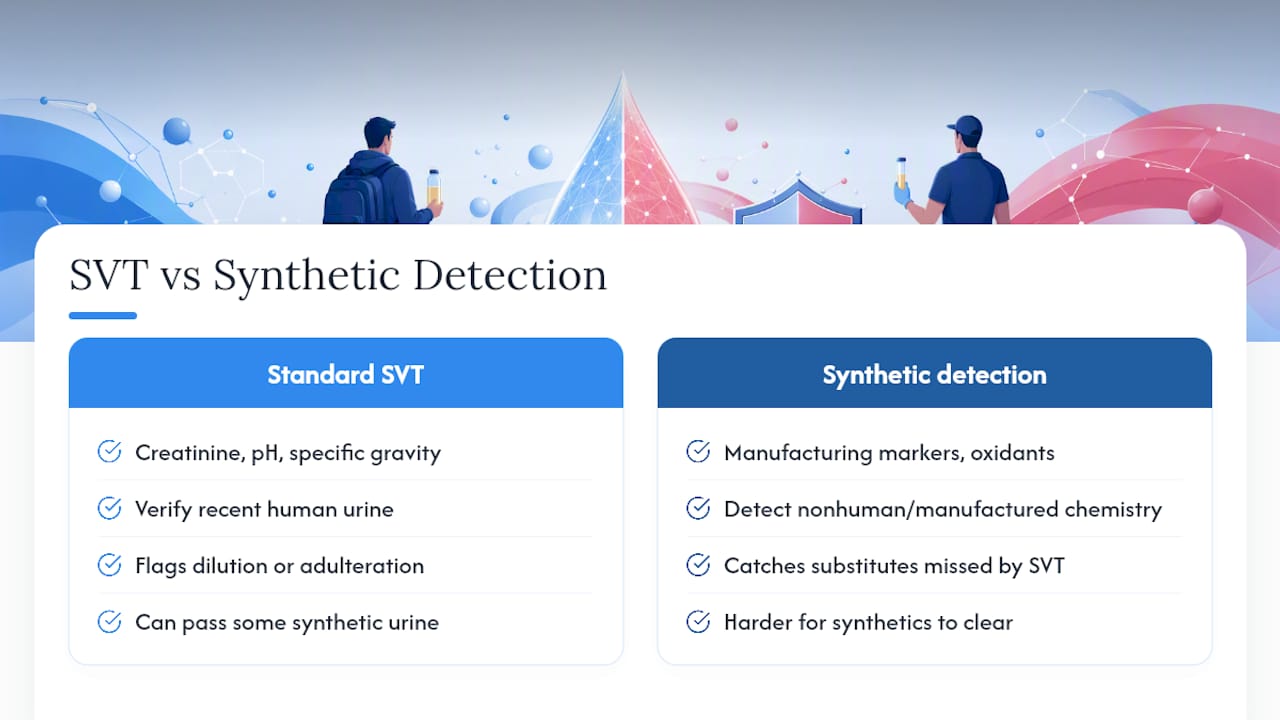
The practical takeaway: temperature and appearance are necessary conditions, not sufficient ones. Formulation quality matters just as much, which is why generic or unverified products carry more risk than one built specifically to clear both standard SVT and synthetic-detection screening.
Can you reheat synthetic urine safely?
Reheating comes up constantly, usually from someone who bought a bottle weeks ago and wants to know if it’s still good. The honest answer is that repeated heating cycles degrade the chemical components that make synthetic urine convincing in the first place.
Every time you heat and cool a sample, the compounds mimicking uric acid and creatinine break down a little further. Do that two or three times and the readings on pH and specific gravity can drift outside the normal range, the exact thing SVT is designed to catch. Product guidance from manufacturers generally recommends using a warmed sample within several hours after warming and avoiding multiple reheat cycles altogether.
If you do need to reheat a sample once:
- Use a heating pad or warm water bath rather than direct heat, which reheats unevenly.
- Avoid metal containers; they conduct heat too fast and risk overheating localized spots.
- Store unused, unmixed synthetic urine in a cool, dark place, away from direct sunlight, until you’re ready to prepare it.
- Check the expiration date again before reheating; heat exposure shortens usable shelf life even for unopened bottles.
Pro Tip: If you’re not confident a sample will be used within a few hours of heating, don’t heat it yet. A cold, freshly warmed bottle beats a reheated one every time SVT results are on the line.
Treat each bottle as single-use whenever possible. The cost of a second kit is nothing compared to the cost of a failed test.
Legal risks and what employers do to stop substitution
Submitting synthetic urine in place of a real sample carries real consequences, and they go beyond a failed test. Depending on the context, employment drug screening, probation, or court-ordered testing, submitting a fake sample can lead to termination, disciplinary action, or in some jurisdictions, criminal charges tied to tampering with a specimen. Rules vary significantly by state and by testing context, so check the specific regulations that apply to your situation before assuming a given approach is low risk.
Synthetic urine does have legitimate legal uses, including lab equipment calibration and training purposes. Using it to defeat a screening test is a different matter entirely, and employers know substitution attempts happen, which is why testing programs keep evolving.
Common countermeasures include:
- Observed collections, where a monitor watches the sample leave the body, which eliminates substitution entirely.
- Switching to hair follicle testing, which covers a much longer detection window and can’t be substituted the way urine can.
- Moving to saliva-based testing, which is harder to defeat because collection happens in front of the tester.
- Adding synthetic-specific detection strips to standard urine collection, closing the gap that basic SVT leaves open.
If you’re facing a testing method that doesn’t rely on urine at all, the calculation changes completely, and it’s worth understanding those formats before assuming a urine-based strategy is even the right approach.
Why most guides oversell the certainty here
Most content on this topic reads like a checklist: hit the temperature, check the pH, walk in confident, done. That framing skips the part that actually matters, which is that detection technology and synthetic urine formulation are locked in a constant back and forth. A product that cleared every check two years ago isn’t necessarily the same product clearing checks today, and plenty of guides never update to reflect that.
The uncomfortable truth is that a warm, correctly mixed sample from a mediocre formula can still get flagged the moment a lab runs a synthetic-specific screen, the kind PubMed’s own evaluation showed catching products that had already passed standard SVT. That’s not a scare tactic. It’s the actual gap between where basic instructions stop and where real risk starts. Anyone treating this as a simple temperature-and-timing exercise is working off outdated assumptions.
What actually reduces risk is pairing correct execution, temperature control, timing, single-use discipline, with a formula built to anticipate both standard SVT and the newer synthetic-detection layer. Skipping either half of that equation is where people get caught, not because they made an obvious mistake, but because they assumed the easy part was the whole job.
— MIchael
Get a lab-grade kit built for both hurdles
PassUSA offers detox and testing solutions for people facing hair, urine, and saliva screenings, with consultation support and a satisfaction guarantee. That track record is why the Ultra Pure line is built to clear both standard SVT and the synthetic-detection layer this guide just walked through, not just the basics.
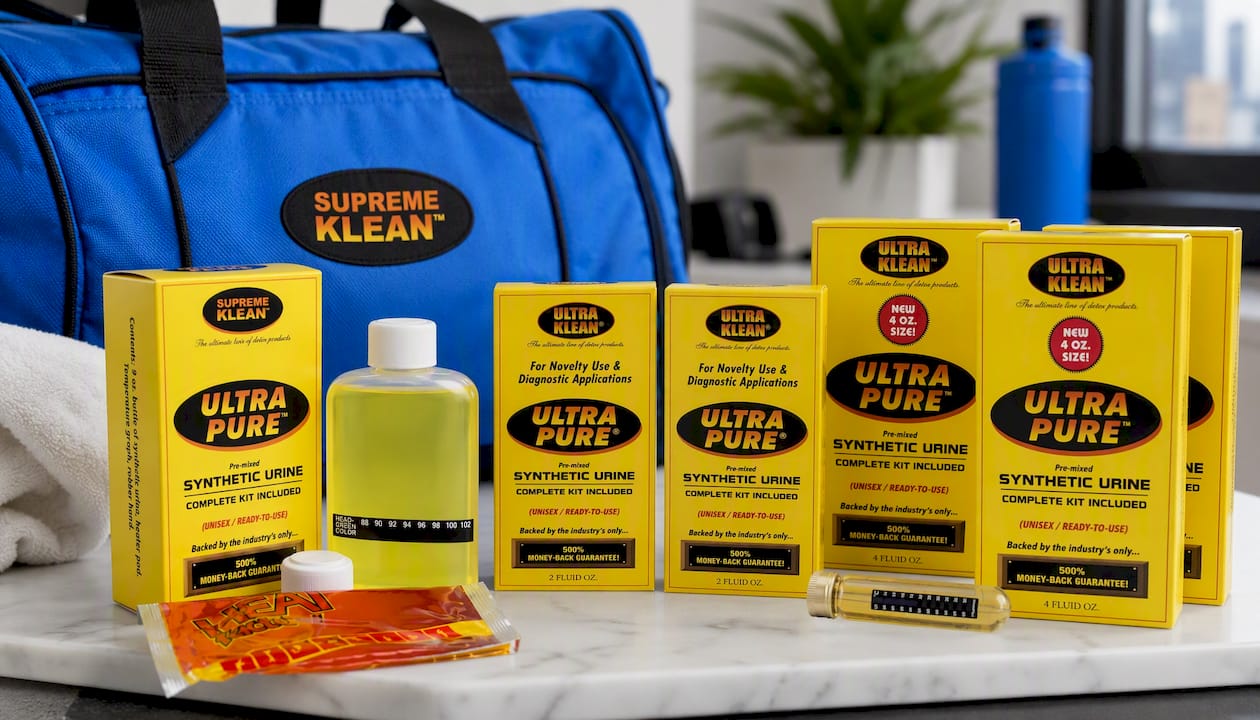
The Ultra Pure Synthetic Urine Kit uses a laboratory-grade formula designed to match human urine chemistry across pH, creatinine, and specific gravity. If you want backup on hand, the 2 oz buy-2-get-1 bundle covers you for more than one attempt, and the multi-pack bundle is built for anyone who tests regularly. Every order comes with access to PassUSA’s consultation support if you have questions about heating, timing, or which kit fits your situation. Pick the bundle that matches how many tests you’re facing and order before your appointment date closes in.
Sources
The claims in this guide rest on lab-facing sources, not marketing copy, and it’s worth checking them directly if you want the technical detail behind SVT and synthetic detection.
- Quest Diagnostics — Specimen validity
- PubMed — evaluation of commercial synthetic urine products
- Aegis Labs — BioDetect clinical update
- Arcpoint Labs — can a lab drug test detect fake urine?