


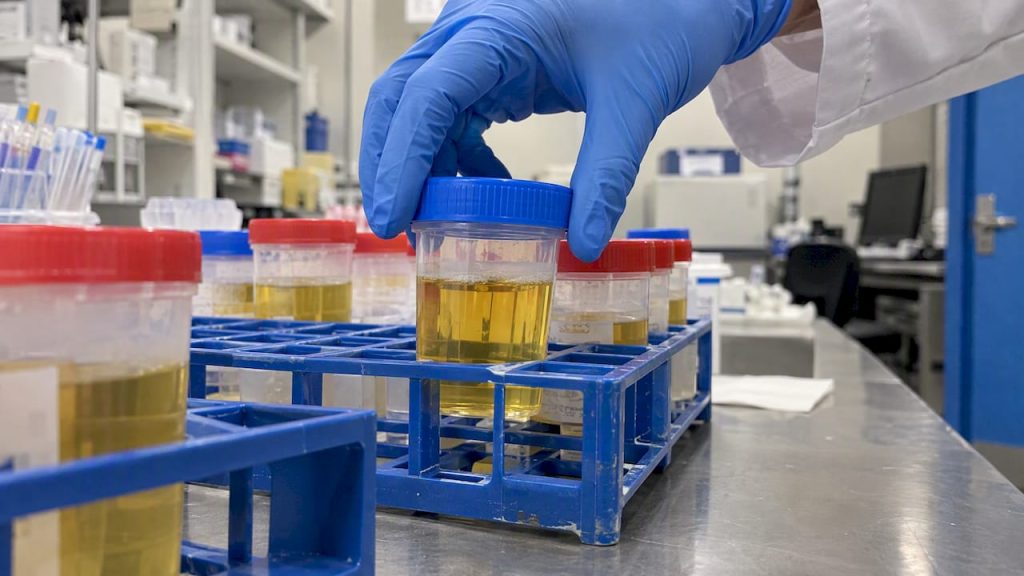
THC metabolites usually show up in a urine test for about 3 days after a single use, around 5 days with moderate use, up to 10 days with daily use, and up to 30 days or more with chronic heavy use. Those are typical figures, not promises. Your body fat, metabolism, hydration, the product you used and the lab’s cutoff all move the number, and that is why two people can use the same amount and get different results.
This guide gives you the ranges, explains what a urine lab actually looks for, and shows how to plan for the test you are facing, including the hair follicle test that most people overlook.
TL;DR
- Typical urine windows: up to 3 days after one use, about 5 days for moderate use, up to 10 days for daily use, and up to 30 days for chronic heavy use (Mayo Clinic Laboratories).
- The standard workplace screen looks for a metabolite, not for THC itself, and the cutoff (50 ng/mL screen, 15 ng/mL confirmation) decides whether a trace counts as positive.
- The commonly cited half-life of the main metabolite is about 6 days, but it cannot tell you the day your own test turns negative.
- A urine test and a hair test are different problems: hair reaches back about 90 days, so a clean urine window does not make you safe on a hair test.
- Know your test type first, then build your preparation around it.
Table of Contents
- How long THC stays in urine by use pattern
- What a urine test actually measures
- Cutoff levels: the number that decides your result
- THC half-life in urine: what it can and cannot tell you
- Factors that change your personal window
- Urine is only one of the tests you may face
- Preparing for a hair follicle test
- Perspective: why we plan by test type, not by guesswork
- Preparing for a urine or saliva test
- Get a plan for your test
- A short checklist before test day
- FAQ
- Sources
How long THC stays in urine by use pattern
The table below pulls together the range most laboratories publish for a standard urine screen. Treat the days as counted from your last use.
| Use pattern | Typical urine detection window |
|---|---|
| Single use | Up to 3 days |
| Moderate use (about 4 times a week) | Up to 5 days |
| Daily use | Up to 10 days |
| Chronic heavy use | Up to 30 days or more |
The figures above come from Mayo Clinic Laboratories’ marijuana drug guide. Other references give slightly different numbers, and that is normal. Detection windows are estimates built from studies of limited groups of people.
Why the “up to 30 days” figure matters
Heavy, long-term users sit at the far end of the range for a reason. A 2026 systematic review found that weekly to daily cannabis users could stay above the 15 ng/mL workplace threshold for weeks after stopping, and it stressed how much individual clearance varies (PubMed). If you have used daily for months, plan for the long end of the range, not the average.
What about a single hit or a vape cartridge?
One hit is the most common question, and the honest answer is that it can still register. In a controlled study of infrequent users, urinary THCCOOH concentrations peaked about 4 to 6 hours after cannabis administration. Using the federal 50 ng/mL screening and 15 ng/mL confirmation criteria, the study found positive results in 47% of vaporized sessions and 21% of smoked sessions (PubMed Central). Those numbers come from lab conditions with set doses, so your own result depends on how much you actually inhaled. Still, “it was only one hit” is not a safe assumption, especially with a potent cartridge. If you vape, our page on detection times for vaping THC goes further.
What a urine test actually measures
A urine test does not look for the compound that makes you feel high. It looks for 9-carboxy-THC, a metabolite your body produces from delta-9-THC (CDC MMWR advisory). That metabolite is stored and released slowly, which is why it outlasts the effects by days or weeks.
This also explains the limits of the test. The same CDC advisory says urine tests only indicate the likelihood of earlier exposure and cannot determine when you used, how much, or whether you were impaired. The American College of Medical Toxicology says the same: urine cannot identify the source, dose or timing of exposure (ACMT position statement).
In plain terms, a positive result tells your employer that metabolite was present above a line. It does not prove when you used. That is useful to know if you are weighing how to prepare, because the line is what you are up against.
Cutoff levels: the number that decides your result
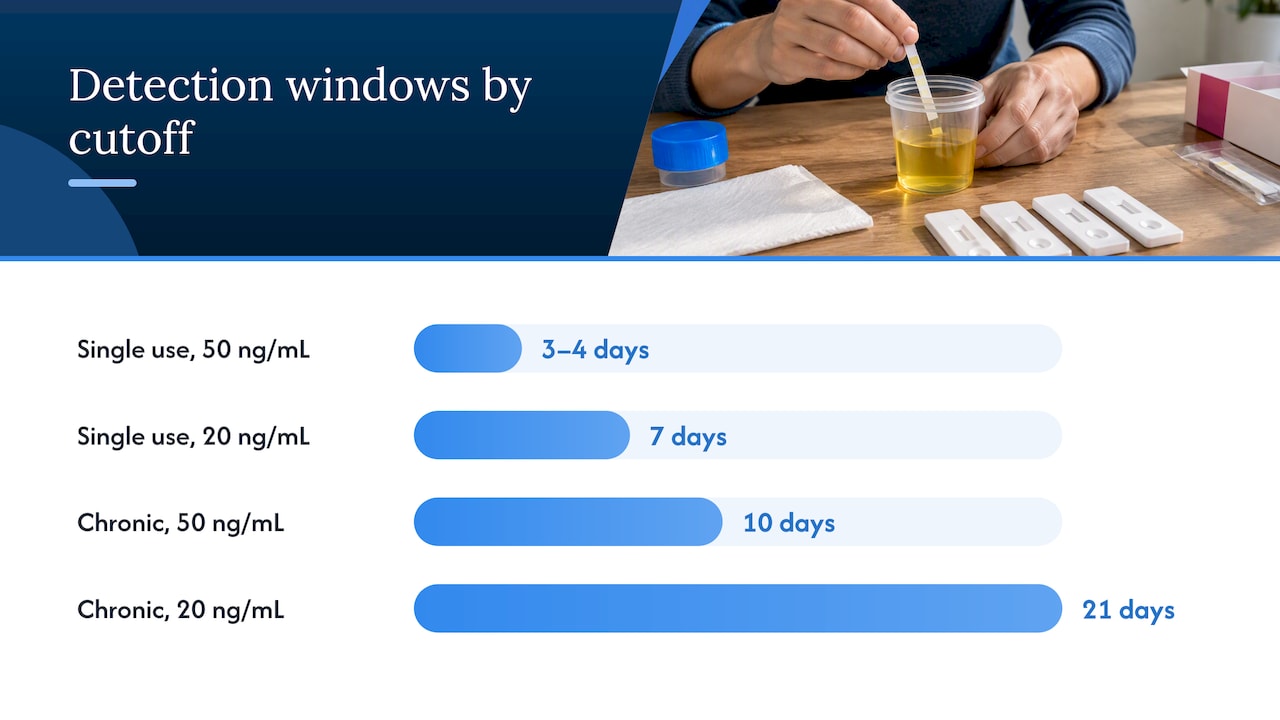
A cutoff is the concentration at which a lab calls a sample positive. The federal screening cutoff for THC metabolite is 50 ng/mL, and the confirmation cutoff is 15 ng/mL. The 2026 review above describes 15 ng/mL total 11-COOH-THC as the typical workplace threshold (PubMed). Some employers and programs use other levels, such as 20 ng/mL, so ask which applies to you. We explain how the two-step process works in our guide to SAMHSA cutoff levels.
Cutoffs change the window noticeably. A fact sheet for drug court practitioners summarizes the science this way (Wisconsin Court System):
| Situation | Cutoff | Typical limit |
|---|---|---|
| Occasional or single-event use | 50 ng/mL | Generally no more than 3 to 4 days |
| Occasional or single-event use | 20 ng/mL | Generally not expected beyond 7 days |
| Chronic use | 50 ng/mL | Unlikely to test positive beyond 10 days |
| Chronic use | 20 ng/mL | Uncommon beyond 21 days |
That fact sheet dates from 2006, so treat it as a guide to how cutoffs shape the window rather than a current rulebook. Its author, a toxicologist at the University of Missouri, also notes that real detection windows are often longer than analytical estimates, because the exact time of last exposure is frequently unknown.
THC half-life in urine: what it can and cannot tell you
People searching for the half-life usually want a formula: if the half-life is X days, I will be clear in Y days. It does not work that way.
The main urinary metabolite, THC-COOH, is often cited as having an elimination half-life of roughly 6 days (PubMed, 2001 study). The same research found that urinary THC itself peaked about 2 hours after smoking and fell to the assay’s detection limit by 6 hours. So the compound drops fast, but the metabolite lingers.
The 6-day figure is an average from a study group. It is not a countdown for your sample, because:
- Your starting concentration depends on how much and how often you used.
- THC can accumulate in body fat, which raises the concentrations you excrete and lengthens detectability (CDC).
- Concentrations in a single sample also move with urine volume, which changes with diet, exercise and age.
Use the half-life to understand why heavy users take longer, not to pick a test date.
Factors that change your personal window
The detection window depends on dose, route, duration and frequency of use, metabolism, the test’s cutoff and its specificity (Wisconsin Court System). In practice, that breaks down like this:
- Frequency of use. This is the biggest single factor. Daily use builds up metabolite faster than your body clears it.
- Potency and dose. Concentrates, high-THC cartridges and edibles deliver more than the flower many studies were built around.
- Body fat and metabolism. THC is stored in fat, so the same dose can linger longer in one person than another.
- Hydration and urine concentration. A first-morning sample is usually more concentrated than one given after drinking a lot of fluid. Excess water can dilute a sample enough that a result comes back negative (ACMT), though labs check samples for dilution, so extreme water loading can create its own problems.
- Exercise. Activity can briefly change how much THC is released from fat. Our page on exercise before a drug test covers what that does and does not mean.
- Test specifics. The cutoff, whether the lab runs a second confirmation, and the sample’s validity checks all matter.
For a wider look at other substances, see our reference on how long drugs stay in your system and our drug detection times chart.
Urine is only one of the tests you may face
Many people spend weeks worrying about urine and then get surprised by a different test. Know which one is on your paperwork.
- Urine: the most common pre-employment and random screen, with the windows above.
- Saliva (oral fluid): catches recent use, often within about a day. Our urine test for THC and marijuana drug testing information pages compare how the methods differ.
- Hair follicle: looks back much further. Hair tests generally cover about 90 days and miss the most recent week or two, because hair takes time to grow out of the follicle (Drugs.com).
That last point is the trap. Someone who stops using for three weeks may be reasonably comfortable on a urine test and still be exposed on a hair test. Read more about why the 90-day hair window can mislead.
Preparing for a hair follicle test
If your employer, a court or a probation officer has named a hair test, the urine timelines above are not your main concern. Hair is the harder test to prepare for, and it is where we put most of our attention.
THC metabolites are carried into the hair shaft as it grows, so a hair sample reflects roughly the past three months. Our approach is built around the Macujo Method, which uses a defined routine of products and washes rather than a single one-time fix. At the center of the hair routine is the Macujo Aloe Rid Shampoo, which is designed to cleanse the hair of toxins before a follicle test. It is meant to be used as part of the step-by-step process, not as a one-off wash.
A few practical points from how we guide customers:
- Start early. The routine is built around a timeline before your test date, so the more days you have, the more complete the preparation.
- Follow the sequence. Timing, wash frequency and technique are part of the method. Our wash calculator and video instructions walk you through them for your hair type and situation.
- Match the plan to the test. Our evidence-based THC hair detox plan explains the process in detail, and our guide for probation drug tests covers the extra concerns when specimens are checked for validity.
If you are not sure how your hair history or timeline fits, a private consultation lets you walk through it with someone who does this every day.
Perspective: why we plan by test type, not by guesswork
After more than 20 years of helping people prepare for drug tests, the pattern we see most is not people who ignore the risk. It is people who prepare for the wrong test. They count days for urine, then get a hair follicle order, or they read a chart average and assume it describes their body.
That is why we start with three questions: which test, how much time, and what your use history looks like. Urine, saliva and hair each need a different plan, and the Macujo Method organizes products and instructions around each one. For hair, the Macujo Aloe Rid Shampoo is the foundation of the routine we built our approach on.
We also believe nobody should have to work this out alone. Our support is designed so that you can ask questions, get a plan for your timeline, and keep asking until you have passed your test. Charts tell you what is typical. A plan built around you tells you what to do.
Detox Experts
Preparing for a urine or saliva test
The urine and saliva situations are simpler on paper but unforgiving about time.
Urine. If you have a few days and light use, time is your friend, since occasional-use windows are short. If you are a frequent user with a test on short notice, the metabolite load is the problem. Do not guess: confirm the cutoff, plan your last use, and consider a screening of your own first. A home dip card lets you see where you stand before the real test, and our 13-panel urine drug test dip card is a clinical-grade option that includes fentanyl. Home screens are not the lab’s confirmation test, so use them as a check, not a verdict.
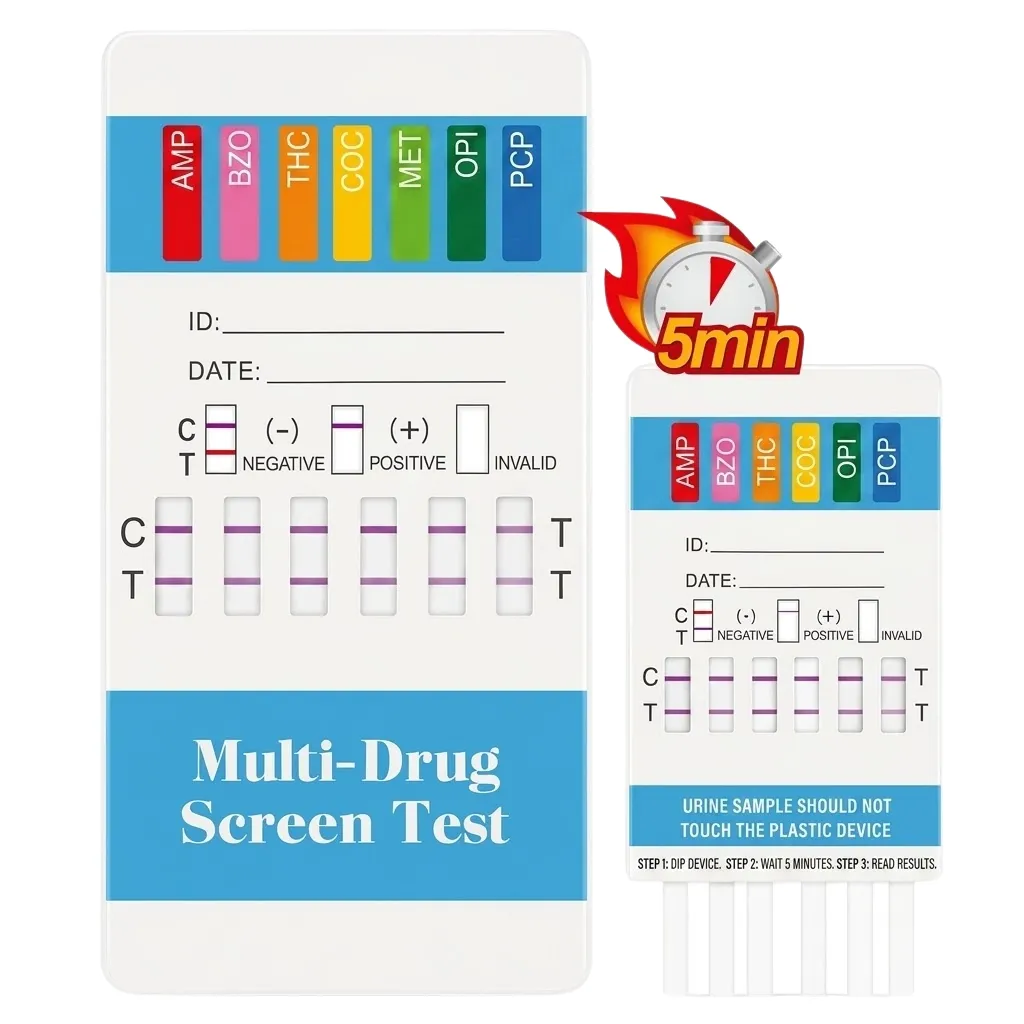
Saliva. Oral fluid tests mainly catch very recent use, so the window is short and the preparation is mostly about timing and mouth hygiene. You can check yourself with the 12-panel oral fluid saliva test before the official one.
Get a plan for your test
We carry products for hair, urine and saliva tests, plus home test kits so you can check where you stand. If you are unsure which combination fits your situation, book a private consultation with Mike Macujo and get step-by-step guidance for your specific test and timeline. You can also browse the full range on the PassUSA homepage.
All of our guidance is built on the Macujo Method, with consultations, video instructions and a wash calculator to take the guesswork out of it.
A short checklist before test day
- Find out the test type: urine, hair or saliva.
- Ask which cutoff applies, or assume the federal 50/15 ng/mL process if you cannot find out.
- Count honestly from your last use, and add time if you used daily or use potent products.
- For hair, start your routine as early as you can.
- Check yourself with a home kit if you have time.
- Bring any prescriptions or documentation you may need to explain.
FAQ
How long does THC stay in urine after one use?
For a single use, most references put detection at up to 3 days (Mayo Clinic Laboratories). Controlled research shows metabolite concentrations peak about 4 to 6 hours after use, so a test taken within a day is the riskiest. Potent products can push that window longer.
What is the half-life of THC in urine?
The main urinary metabolite, THC-COOH, is often cited as having a half-life of about 6 days (PubMed). That is a group average and does not predict the exact day your own test turns negative. Frequency of use and body fat change how long it takes.
Can a urine test show when I used?
No. The CDC advisory says a urine test indicates the likelihood of earlier exposure but cannot determine timing, dose or impairment (CDC). This is why windows are expressed as ranges.
Will I fail a urine test if I smoke once a week?
It is possible, depending on how recently you used and which cutoff applies. Occasional-use research suggests windows of roughly 3 to 7 days depending on whether the cutoff is 50 or 20 ng/mL (Wisconsin Court System). Leave a wider margin if your products are strong.
Does a clean urine test mean I will pass a hair test?
Not necessarily. Hair tests generally reach back about 90 days, so use that ended weeks ago can still appear in hair. If a hair test is possible, prepare for it separately, and our hair detox plan explains how.
Sources
- Drug Testing: Marijuana, Mayo Clinic Laboratories
- Urinary Δ9-tetrahydrocannabinol and metabolite systematic review, PubMed
- Urinary Excretion Profile of cannabis, PubMed Central
- Urine Testing for Detection of Marijuana: An Advisory, CDC MMWR
- Drug court practitioner fact sheet: The marijuana detection window, Wisconsin Court System
- Temporal indication of marijuana use, PubMed
- ACMT Position Statement: Interpretation of Urine for drugs, PubMed Central
- How long does Marijuana stay in your system?, Drugs.com